The Essence Of Ramadan Is For All of Us
Ramadan 1447/2026
At a retreat I attended a few years ago, a speaker asked what or where home is to us. Two thoughts came to mind. The first: my mother—the body and love that grew me into being. The second: Ramadan, the ninth lunar month of the Islamic calendar.
How can a month be a home? How can a season be a home?
Fasting (along with the other sacred practices of this time) forces a slowness that feels radical in a world that worships speed. The ego craves movement, distraction, and excess, but Ramadan demands a return to the essential. In its stillness, it becomes a clearing—a reminder that I am a part of something much larger than myself.
Ramadan cracks open the hardened shells of habit, carving space for reflection. Ramadan is a medicine that calibrates to the moment. Its beauty isn’t in making you feel good. It’s in making you feel.
It’s a holy experience returning you to your wholeness. A state of being I find myself in an almost perpetual state of yearning for. Homesickness.

Moving Beyond The Surface
I have been moved by gestures of allyship that have been growing in recent years: a handwritten “Ramadan Mubarak” sign at my local spice shop, Ramadan lights in central London, and a steady stream of messages from non-Muslim friends.
These gestures offer small moments of reprieve in a world where Islamophobia’s impact is palpable on a daily basis—enabling violence, ethnic cleansing, and harmful policies.
In the same vein, the rich dynamism of this season gets flattened. So much of the information shared about Islam’s holy month focuses on the mechanics: abstaining from food and drink from sunrise to sunset for an entire month. (“Not even water?” is a now ubiquitous phrase of Muslim internet memedom.) We Muslims often fall into this pattern ourselves, for simplicity’s sake. How can we quickly convey what this season truly represents?
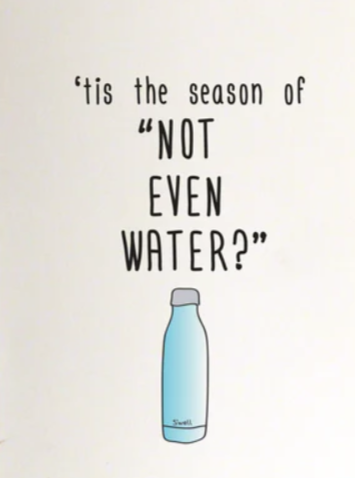
The cover of my favorite Ramadan card, available at:
https://shopkishmish.com/products/not-even-water
The Inner Essence
The essence of Ramadan is hard to describe. It is part celebration, part holy season. It is a time of coming together and also a time of solitude and reflection. In being asked to describe what feels indescribable, it feels easier to focus on the mechanics. Add on a fear that extolling Ramadan’s inner meanings might be misunderstood as proselytizing and the fact that, in a community of over 1.7 billion, what people understand as the “inner meanings” of Ramadan varies, it seems better to stick to the observable facts.
Yet, I feel strongly that the essence of Ramadan is for all of us.
We are living in a time of intense disconnection and destruction. Excessive consumption has our minds, bodies, spirits, and planet on the brink. Ramadan is an invitation to heal and step into another way of being with the world and one another. And this is my invitation for all to join me — whether or not you fast, practice Islam, or have any religious inclinations whatsoever — in contemplating the essence of Ramadan.
So, what is this “essence”? And what does it mean to participate in Ramadan’s transformative change? To me, it begins with a sincere contemplation of three elements: our relationship to our bodies, our relationship to consumption, and our relationship to community.
How Do We Partner with Our Body?
The body and spirit connection in Islam is profound; the two aspects are inextricably linked. While fasting, I personally feel much more embodied. I feel my humanness; I feel deeply aware and appreciative of my body. The body is not an obstacle to overcome, it is a partner in the spirit’s journey. The fast is not a punishment of the body but an acknowledgment of this sacred partnership. (And, thanks to the intermittent fasting trend, there’s a growing body of research on the healing benefits of this practice as well).
Ramadan also reminds us of our place in the natural world. In contrast to the Descartian worldview of, “I think, therefore I am,” Ramadan reminds us, “I feel, therefore I am.” To feel the pangs of hunger and thirst is to feel the weight of our profound interconnectedness, a reminder of survival’s common denominator — the need for food and drink — connecting every single human and living being on this planet.
What Do We Truly Need?
Ramadan disrupts consumption as the central organizing principle of our lives. When you take food and drink out of the equation — during daylight hours — it cracks open your routine and pushes you to deeply consider how you want to shape your day and what you truly value. The fast also requires intentionality around what is being ingested in all aspects. What are you putting into your body via your ears and eyes? By creating distance in our relationship with consumption, there is more space for our relationships and other priorities.
Our Relationship with Community: How Do We Support Each Other?
Ramadan is also a time of redistribution and reciprocity. This is the season where many Muslims calculate their resources and give a portion of their assets to community members in need. This practice, called Zakat, is founded on the central notion that nothing truly belongs to or comes to us via our individual efforts alone, and, as such, must be shared. Zakat parallels the process of fasting. With the fast, the body is consuming less and redistributing its energy and focus. Materially, we bring that process to life by giving from whatever wealth we have accumulated. In this way, we practice Zakat with the entirety of our being. It is a way of embodying our commitment to community; sweeping away excesses in order to draw closer to our community.
A Collective Gift
These reflections are but a small snapshot of Ramadan’s multifaceted inner landscape. The external ritual of the fast is a protective layer; a husk holding a seed’s tender core and multiple meanings.
Muslims comprise almost a quarter of the world’s population. We exist in every corner of the globe. Ramadan is our annual reminder of who we are and who we belong to; it is a gift that nudges us, collectively, toward a healthier and more balanced life. And while gifts can be personal treasures, they are best appreciated when shared with others.
Allahu a’alam.*
*“God knows best.” This phrase, often spoken by Muslims after sharing religious knowledge, acknowledges the limitations of human interpretation. To me, it also honors the diversity of experiences within the Muslim community. Thank you for considering mine.
An earlier version of this article appeared in The Inclusion Solution in 2023.